A performance exhaust system is a series of piping and components designed to manage the flow of waste gases from an internal combustion engine. It serves to direct exhaust gases away from the engine and out of the vehicle while managing the pressure, temperature, and noise levels produced during the combustion process. By optimizing the path these gases take, a performance exhaust system aims to improve the efficiency of the engine’s breathing cycle.
Standard factory exhaust systems are often designed to prioritize noise suppression and emissions compliance over engine efficiency. These systems frequently use restrictive components that create significant backpressure. A performance exhaust system solves this by reducing flow resistance, allowing the engine to expel spent gases more rapidly. This reduction in backpressure allows the engine to pull in a fresh air-fuel mixture more efficiently, which can improve throttle response and power delivery at higher RPMs.
How does a performance exhaust system work?
A performance exhaust system works by creating a low-resistance pathway for gases to travel from the cylinder head to the rear of the vehicle in a specific sequence.
- The exhaust gas exits the cylinder head and enters the primary headers or manifold, where the initial expansion occurs.
- The gas travels through the primary piping toward the catalytic converter or resonator, where the flow is managed to meet legal environmental standards.
- The gases move into the mid-pipe, where the diameter of the tubing determines the velocity and pressure of the flow.
- The exhaust reaches the muffler or resonator, which uses internal chambers to dampen sound waves.
- The gas exits through the tailpipes, where the final shape and diameter determine the final exit velocity and sound profile.
Performance Exhaust Systems we have reviewed in detail
Prices across these 3 run from $149.99 to $775; each one has a full review here.
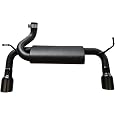
MagnaFlow Performance Exhaust System 15160
$775 price checked August 2026
Read our full MagnaFlow 15160 review
If you own a pony car, see our top-rated Ford Mustang GT exhaust options.


BORLA 11795 Axle-Back Performance Exhaust System
$149.99 price checked August 2026
Read our full BORLA 11795 Exhaust review
To better understand the technical data, view the breakdown of common exhaust terminology.
What parts of a performance exhaust system matter most?
The components of a performance exhaust system vary based on how much of the original factory system they replace and the materials used in their construction.
Headers and Manifolds
The manifold is the first point of contact for exhaust gases. Headers are a specific type of manifold designed with “log” or “tri-y” shapes to increase the surface area and improve the scavenging effect, which is the process of using the velocity of exiting gases to help pull the next pulse out of the cylinder.
Catalytic Converter
The catalytic converter is a regulated component that uses a chemical coating to convert harmful pollutants into less harmful gases. While not a “performance” part in terms of flow, its placement and the diameter of the piping leading into it dictate how much restriction the engine faces before the gas reaches the rest of the system.
Mid-pipe and Piping
The mid-pipe is the section of tubing between the catalytic converter and the muffler. The diameter of this piping is a critical spec; if the pipe is too small, it creates backpressure that limits high-RPM power. If it is too large, it can cause a loss of exhaust velocity at lower RPMs, leading to a sluggish feel.
Mufflers and Resonators
Mufflers reduce noise by creating turbulence or using chambers to cancel out sound waves. Resonators are smaller components that target specific frequencies of drone. A performance exhaust system often uses high-flow mufflers that prioritize gas movement over extreme silence.
Tailpipes
Tailpipes are the final exit point. The diameter and tip design of the tailpipes affect the final exit velocity. Proper sizing ensures that the gas does not “bottle up” at the very end of the system, which would cause heat buildup and restricted flow.
What changes in practice with a performance exhaust?
A performance exhaust system changes the behavior of the vehicle by altering the relationship between engine RPM and power delivery.
Make sure you stay within legal limits by viewing how to choose your exhaust decibel level.
Power and Response
In practical use, a performance exhaust system often results in a more linear power band. Because the engine can “exhale” more easily, the driver may notice a quicker response when the throttle is applied, particularly in the mid-to-high RPM range. This is because the engine does not have to work as hard to overcome the resistance of a restrictive factory muffler.
Sound Profile
The sound profile changes significantly because the resonance of the exhaust is altered. A performance system typically produces a deeper, more consistent tone than a stock system. However, it is important to note that a system with a very large diameter may result in a quieter “drone” at highway speeds if the exhaust velocity is too low to create a distinct note.
Where it does not change
A performance exhaust system does not provide a significant change in low-end torque or fuel economy for most street-driven vehicles. Because the most restrictive parts of the system are often the catalytic converter and the engine’s own internal geometry, the gains from the piping alone are often subtle. For many drivers, the primary change is the auditory experience rather than a measurable increase in horsepower.
Who needs a performance exhaust system?
The need for a performance exhaust system depends on the specific goals of the vehicle owner and the mechanical limits of the engine.
Power Seekers
Drivers who seek to maximize the output of a turbocharged or high-displacement engine need a performance exhaust system. These engines produce high volumes of gas that require large-diameter piping to prevent the engine from “choking” under heavy load.
Sound Enthusiasts
Owners who want a more aggressive or refined engine note without changing the engine’s internal components need a performance exhaust system. This is the most common reason for the upgrade, where the goal is to change the acoustic signature of the vehicle.
Who does not need one
Drivers of standard commuter vehicles who prioritize fuel economy and a quiet cabin do not need a performance exhaust system. In these cases, the stock exhaust is already optimized for the engine’s output, and a performance upgrade would likely result in a louder cabin environment with negligible gains in drivability.