Decibel level measures the intensity of the sound produced by a performance exhaust system, expressed in dB. The specific value you need depends entirely on your local noise ordinances, your personal preference for engine note, and your intended driving environment.
Which Decibel Level Suits Your Situation?
| If this is you | The Decibel Level that suits you | Why |
|---|---|---|
| You live in a dense urban area or a neighborhood with strict noise bylaws. | 80 dB to 90 dB | These levels typically mimic the volume of a stock factory exhaust while providing a deeper tone. |
| You primarily drive on public roads and want a noticeable but respectful note. | 90 dB to 95 dB | This range provides a clear auditory signature without attracting excessive attention from law enforcement. |
| You are a track day enthusiast or a weekend hobbyist who prioritizes sound. | 95 dB to 105 dB | Higher decibel levels allow the engine’s character to dominate the cabin and the immediate surroundings. |
| You own a dedicated off-road vehicle or a track-only car with no street use. | 105 dB and above | Maximum flow and sound are prioritized here as there are no restrictions on public road noise limits. |
Products in this category with a full review here
3 reviewed options, $276.99 to $873.05, with the full write-up behind each name.
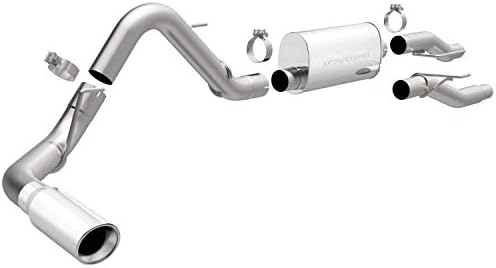
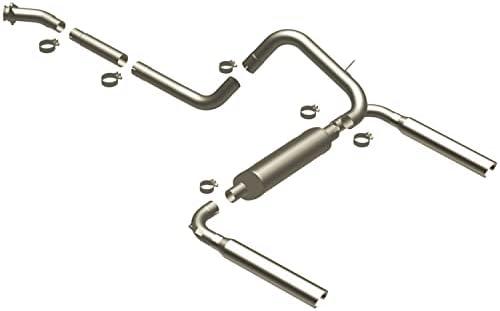
MagnaFlow Cat-Back Performance Exhaust System 16829
If you are working with a specific budget, see the best cat-back performance exhaust system under $1700 to find the top-rated options.
$276.99 price checked August 2026
MagnaFlow Performance Exhaust System 15160
$775 price checked August 2026
Read our full MagnaFlow 15160 review
Understanding the build quality is essential, so explore the different material grades for performance exhausts to see which suits your needs.
How do I find the decibel level of a performance exhaust?
To find the decibel level of a performance exhaust, you must look for the dB rating in the manufacturer’s technical specifications or on the product packaging.
Manufacturers usually provide a laboratory-tested decibel rating, which measures the sound output at a specific distance, such as 1 meter or 3 meters, from the exhaust tip. Because these tests are conducted in controlled environments, the real-world volume may vary based on your vehicle’s engine displacement, the diameter of the piping, and the specific muffler design used in the kit.
If a manufacturer does not list a specific dB value, they may instead provide a “drone” rating or a description of the sound profile (e.g., “quiet,” “aggressive,” or “raspy”). In these cases, you should look for the internal diameter of the piping and the material used, as larger diameters and thinner walls typically correlate with higher decibel outputs.
Before ordering, you can establish your own requirements by checking local municipal codes. Many cities set a limit of 80 dB or 90 dB for vehicles on public streets. Identifying these legal limits first ensures the system you choose does not result in a citation or a forced removal of the parts.
What happens if the decibel level is too high or too low?
The risks of a decibel level that is too high
A decibel level that is too high for your environment can lead to frequent interaction with law enforcement and potential fines for noise violations. Beyond legal issues, excessively loud exhaust systems can create a “drone”—a constant, vibrating hum that resonates through the cabin at sustained highway speeds.
Choosing the right layout is also important; learn about various exhaust configurations for performance exhausts to find your ideal setup.
This drone can become physically fatiguing over long distances, making it difficult to hold conversations or hear the radio. If the exhaust is designed for high-flow performance without sufficient baffling, the resonance can also cause interior trim pieces to vibrate or rattle against one’t body panels.
The risks of a decibel level that is too low
A decibel level that is too low often indicates that the exhaust system is heavily restricted by the muffler or the piping diameter. While this keeps the vehicle quiet, it can limit the performance benefits of an aftermarket system by creating backpressure.
When the exhaust cannot move air efficiently, the engine may struggle to reach its peak power at high RPMs. You may notice a “muted” sound that lacks the crispness of a performance system, and the vehicle might feel less responsive during hard acceleration compared to a system with a more open flow profile.
What if I fall between two decibel levels?
If your requirements fall between two decibel levels, such as a choice between a 90 dB and a 95 dB system, you should prioritize the “drone” characteristics and the flow diameter over the raw decibel number. A 90 dB system with a large diameter and high-quality T-304 stainless steel construction may provide a better driving experience than a 95 dB system that uses smaller piping and creates a harsh resonance.
In these borderline cases, it is safer to choose the lower decibel rating. It is much easier to find a way to make a quiet system sound slightly more aggressive through different tip designs than it is to dampen a system that is already exceeding local noise limits or causing cabin fatigue.
Always confirm the specific pipe diameters of the options you are considering. If two systems offer similar decibel levels, the one with the larger diameter will generally provide a smoother, more consistent exhaust note and better high-end flow.