Most performance exhaust systems require a pipe diameter between 2.5 in. and 3.5 in. depending on the engine displacement and intended use. Selecting the correct diameter ensures the engine can breathe efficiently without creating excessive backpressure or losing exhaust velocity.
Recommended Pipe Diameter for Performance Exhaust Systems
| Use Case | Recommended Pipe Diameter | Why this number? |
|---|---|---|
| Small Displacement (Under 2.0L) | 2.0 in. to 2.5 in. | Maintains high gas velocity to ensure efficient scavenging in smaller cylinders. |
| Mid-Sized Engines (2.0L to 4.0L) | 2.5 in. to 3.0 in. | Balances flow volume with the velocity needed for street-legal power bands. |
| Large Engines (Over 4.0L V6/V8) | 3.0 in. to 3.5 in. | Reduces backpressure for high-volume exhaust pulses from large displacement units. |
| High-Output Racing / Turbocharged | 3.5 in. to 4.0 in. | Accommodates the massive volume of gas produced by forced induction or high-RPM racing. |
Where these choices show up in our reviews
3 reviewed options, $693.62 to $873.05, with the full write-up behind each name.

Gibson Performance 65658 Stainless Dual Extreme Cat-Back
$693.62 price checked August 2026
Read our full Gibson Performance 65658 Stainless Dual Extreme Cat-Back review
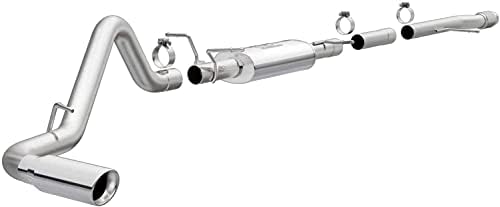
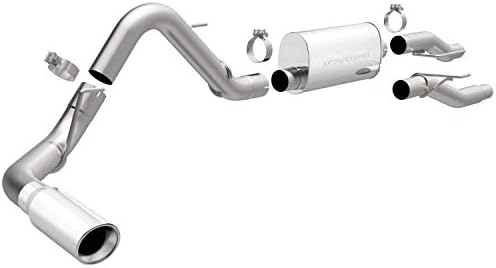
MagnaFlow Performance Exhaust System 15267
$864.99 price checked August 2026
If you are looking for a simpler setup, view our top axle-back performance exhaust system picks.
What Happens if You Go Under or Overbuy Pipe Diameter?
Under-provisioning occurs when the pipe diameter is too small for the engine’s output. This creates a restriction known as backpressure, which acts like a bottleneck for the engine.
Owners of the hatchback should compare the best performance exhaust system for honda civic options.
Risks of Under-Provisioning
When the pipe diameter is too small, the exhaust gases cannot exit the manifold and headers quickly enough. This creates a pressure buildup that can cause the engine to lose power at high RPMs, as the engine cannot “exhale” as fast as it “inhales.” In extreme cases, restricted flow can lead to increased exhaust gas temperatures, which may stress internal engine components or cause the exhaust system to operate near its thermal limits.
Furthermore, restricted flow often results in a distinct acoustic profile. Because the gases are forced through a narrow opening, the exhaust note may become harsher or higher-pitched. For a reliability-first buyer, under-provisioning is a risk because it limits the potential of the engine and can lead to unnecessary heat buildup in the exhaust piping.
Over-provisioning occurs when the pipe diameter is significantly larger than what the engine’s displacement or power output requires. While it might seem like “more is better,” a pipe that is too large can actually degrade performance.
Risks of Over-Provisioning
The primary issue with over-provisioning is the loss of exhaust velocity. Exhaust gases need to move at a specific speed to create a vacuum effect (scavenging) that helps pull the next cycle of gases out of the cylinder. If the pipe diameter is too large, the gas expands and slows down, losing the momentum required for efficient scavenging.
This loss of velocity can result in a sluggish feeling in the lower RPM range, where the engine relies on gas velocity for power. Additionally, a pipe that is too large may produce a “drone” or a hollow, echoing sound because the larger internal volume creates a different resonance chamber. For many street-driven vehicles, an oversized pipe can make the cabin experience less pleasant at highway speeds.
The Mistake Most Buyers Make with Pipe Diameter
The most common mistake buyers make with pipe diameter is assuming that a larger diameter always equals more power. Many buyers look for the largest number available in a catalog, assuming it will provide the greatest performance increase.
Optimising for Velocity Instead of Volume
Instead of focusing solely on the maximum volume the pipe can hold, you should focus on maintaining exhaust velocity. For most street-legal applications, the goal is to find the “sweet spot” where the pipe is large enough to eliminate restrictive backpressure but small enough to maintain the kinetic energy of the exhaust gases.
You should also consider different exhaust configuration for performance exhausts before making a final purchase.
A high-flow exhaust system is most effective when the diameter matches the engine’s volumetric efficiency. If you are running a naturally aspirated engine, velocity is king. If you are running a heavily turbocharged engine, volume becomes more important because the sheer amount of gas produced by the turbo requires a larger exit path regardless of velocity.
How Pipe Diameter Interacts with Other Deciding Specs
Pipe diameter does not exist in a vacuum; its effectiveness is limited by the other components of the performance exhaust system. If one component is restrictive, a larger pipe diameter will provide diminishing returns.
The Header and Manifold Limitation
The headers or exhaust manifolds are the first point of exit for the engine. If the headers have a small primary tube diameter, increasing the downstream pipe diameter will have a negligible effect on performance. The system is only as efficient as its most restrictive point. You must ensure that the diameter of the headers aligns with the diameter of the rest of the system to maintain a consistent flow path.
Catalytic Converter and Muffler Constraints
In many regions, the catalytic converter is a mandatory component. These units are often the most restrictive part of the exhaust system. If the catalytic converter is designed for a 2.5 in. flow, installing a 3.5 in. pipe after it will not increase the flow rate of the system. The converter remains the bottleneck.
Similarly, the muffler’s internal baffling determines the final exit flow. A high-flow muffler with a large inlet will allow the pipe diameter to do its job, but a restrictive, “quiet” muffler will negate the benefits of a larger pipe. When choosing a system, ensure that the flow ratings of the mufflers and converters are compatible with the pipe diameter you have selected.
Material Standards and Heat Management
The material of the exhaust system, such as T-304 stainless steel, also interacts with diameter. Larger diameter pipes have more surface area and can radiate more heat. While T-304 stainless steel is the industry benchmark for corrosion resistance, the thickness of the material must be sufficient to handle the heat and pressure of the chosen diameter. Proper material selection ensures that the pipe maintains its shape and integrity over time, regardless of the diameter chosen.