Exhaust configuration defines the specific physical layout and component coverage of a performance exhaust system. The configuration you choose depends on your specific goals for power gains, noise levels, and the amount of labor you intend to authorize for the installation.
Which Exhaust Configuration Suits My Goals?
| If this is you | The Exhaust Configuration that suits you | Why |
|---|---|---|
| You want the most significant power gains and the highest level of flow. | Cat-Back | Replacing everything from the catalytic converter back optimizes the entire downstream flow path. |
| You want a noticeable change in sound and aesthetics with less labor. | Axle-Back | Replacing only the muffler and tips provides a distinct acoustic profile while avoiding the catalytic converter. |
| You are on a strict budget and only want to change the final output. | Muffler Delete or Tip Upgrade | These provide the most basic configuration changes with the lowest cost and minimal hardware replacement. |
| You need to maintain strict emissions compliance while improving flow. | Mid-Pipe or High-Flow Cat-Back | These configurations focus on the downstream piping while keeping the primary catalytic converter intact. |
Where these choices show up in our reviews
These 3 have their own full review on this site, and run from $693.62 to $949.05.


Gibson Performance 65658 Stainless Dual Extreme Cat-Back
If you are on a budget, see our comparison of affordable cat-back systems to find the best value under $1700.
$693.62 price checked August 2026
Read our full Gibson Performance 65658 Stainless Dual Extreme Cat-Back review
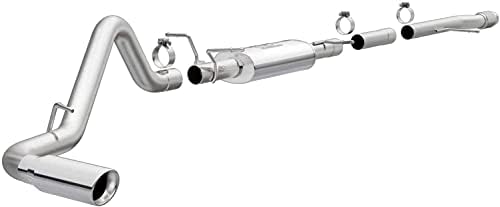
MagnaFlow Performance Exhaust System 15267
$864.99 price checked August 2026
Read our full MagnaFlow 15267 review
Understanding noise output is crucial, so learn how to measure exhaust decibel levels before making your final choice.
How Do I Measure My Current Exhaust Configuration?
To establish your current exhaust configuration, you must identify which components are currently installed on your vehicle’s chassis. This is typically determined by locating the catalytic converter and identifying the point where the exhaust piping begins to change diameter or material.
Locating the Catalytic Converter
The catalytic converter is the primary anchor point for determining configuration. It is usually located near the engine block or under the center of the vehicle. If your current setup replaces the pipe starting immediately after this component, you are looking at a Cat-Back configuration. If the current system leaves the converter and the preceding piping untouched, it is an Axle-Back configuration.
Verifying Pipe Diameter and Material
You should check the diameter of your existing piping to ensure the new configuration matches your vehicle’s flow requirements. Standard performance upgrades often move from a factory diameter to a specific measurement like 2.5 inches or 3 inches. You can find the current diameter by measuring the outer diameter of the pipe at the midpoint of the exhaust system. Note that the diameter should be confirmed with a qualified installer to ensure the flow remains balanced for your specific engine displacement.
What Happens If I Choose the Wrong Exhaust Configuration?
Choosing an exhaust configuration that is poorly matched to your vehicle’s requirements leads to specific mechanical and auditory failures. These issues manifest differently depending on whether the configuration is under-engineered or over-engineered for the specific engine output.
The Risk of Restricted Flow
If you select a configuration that retains too much restrictive piping or uses a diameter that is too small for your engine’s displacement, you will experience restricted flow. This creates backpressure that prevents the engine from breathing efficiently at high RPMs. In use, this feels like a “choked” sensation where the engine lacks the expected power curve at the top end of the rev range.
Durability depends on construction, so compare different performance exhaust material grades to ensure long-term reliability.
The Risk of Drone and Resonance
Selecting a configuration that provides too much volume or lacks sufficient baffling for your vehicle’s cabin can result in drone. Drone is a constant, irritating hum that occurs at specific highway speeds. If the exhaust configuration does not account for the resonance of your specific vehicle’s body, the cabin noise can become exhausting during long drives.
The Risk of Heat Shielding Failure
An incorrect configuration might place exhaust piping too close to interior trim or sensitive components. If the piping is not properly shielded or routed for the specific configuration, it can lead to heat shielding failure. This manifests as melting interior plastics or the degradation of nearby components due to excessive radiant heat.
What Should I Do if I Fall Between Two Configurations?
If your requirements fall between two configurations, such as wanting the power of a Cat-Back but the ease of an Axle-Back, you should prioritize your primary objective. If your goal is power, the Cat-Back is the necessary choice; if your goal is cost and ease of installation, the Axle-Back is the correct path.
Prioritizing Power Gains
When caught between configurations, choosing the one that offers more comprehensive piping replacement is the standard path for performance-oriented builds. A Cat-Back system ensures that the entire exhaust path is optimized for flow, which is the primary requirement for high-output engines. If you need the power, do not compromise on the configuration by choosing a less comprehensive system.
Prioritizing Installation Labor
If your primary concern is the time and cost of the installation, you should move toward the less invasive configuration. Axle-Back systems are significantly faster to install because they do not require the removal of the catalytic converter or the complex mid-pipe welding. If you want a noticeable change without the complexity of a full system, the Axle-Back is the logical choice.
The Necessity of Professional Fitting
Regardless of which configuration you choose, the installation of a performance exhaust system is a job for a qualified installer. Because these systems involve high-heat components and specific mounting points, a professional ensures that the configuration is secured correctly and that all heat shielding is adequate. You should confirm with the installer that the chosen configuration is compatible with your specific vehicle’s chassis before they begin the work.