Connection type for dual exhaust systems refers to the specific mechanical method used to join the new exhaust pipes to the vehicle’s existing exhaust manifold or piping. Your specific vehicle’s factory configuration, available space, and your preference for permanent versus modular installation determine which connection type is appropriate for your project.
Which Connection Type Suits My Vehicle?
| If this is you | The Connection Type that suits you | Why |
|---|---|---|
| You want a permanent, factory-integrated look for a dedicated project vehicle. | Weld-on connections | Welding creates a single, seamless piece of metal that eliminates joint movement and maximizes flow. |
| You need to remove the system easily for maintenance or to switch between different setups. | Clamp-on connections | Clamps allow for a modular design that can be disassembled without specialized welding equipment. |
| You are working with a high-heat area where vibration is a primary concern. | Weld-on connections | Welded joints are less prone to loosening over time compared to mechanical fasteners under high-frequency vibration. |
| You are performing a temporary modification or a “bolt-on” upgrade for a daily driver. | Clamp-on connections | These provide a reliable seal that can be adjusted or replaced quickly if the alignment shifts. |
| You have a custom-fabricated exhaust layout that requires precise flow dynamics. | Weld-on connections | Welding allows for the use of mandrel bends and custom-tapped ports that cannot be achieved with standard clamps. |
Dual Exhaust Systems covered by our own reviews
3 reviewed options, $227.99 to $849.99, with the full write-up behind each name.
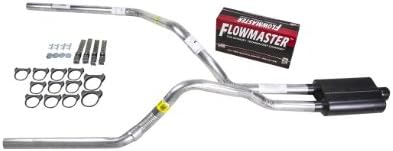

MBRP S4202409 3″ Cat Back Dual Outlet Exhaust
$594.99 price checked August 2026
Read our full MBRP S4202409 Exhaust review
You should also compare different exhaust material grades to find the best durability for your specific vehicle’s needs.
How Do I Measure and Establish My Connection Requirements?
To determine the correct connection type, you must first identify the diameter and material of your vehicle’s current exhaust output. Most manufacturers list the exhaust pipe diameter in the owner’s manual or on the underside of the existing piping, typically measured in inches (e.g., 2.5-inch or 3-inch piping).
You should measure the outer diameter (OD) of the existing pipe using a large caliper or a diameter tape. Ensure you are measuring the pipe itself, not the flange or the mounting bracket. Knowing the exact OD ensures that the new dual exhaust kit will seat correctly against the factory outlet.
Identify the material of the existing pipe, such as aluminized steel or T304 stainless steel. Matching the material of the connection point to the new system helps prevent galvanic corrosion, which occurs when two dissimilar metals are in contact. If the factory pipe is stainless, a stainless steel connection point is the standard choice.
Check the clearance around the connection point. Measure the distance between the exhaust outlet and the nearest chassis component, such as the frame rail or a heat shield. If the space is extremely tight, a clamp-on connection might offer more flexibility for slight misalignments, whereas a weld-on connection requires the parts to line up perfectly before the weld is made.
Verify the mounting orientation. Note whether the factory outlet is a straight pipe or a flanged port. If it is a flanged port, you may need a specific adapter to transition from the flange to the dual exhaust piping, regardless of whether you ultimately choose a welded or clamped final connection.
What Happens if the Connection Type is Incorrect?
The Risk of Restricted Flow
If a connection type creates a bottleneck, it results in restricted flow. This occurs when the diameter of the connection point is smaller than the diameter of the dual exhaust piping. Restricted flow creates backpressure, which can lead to higher exhaust gas temperatures (EGTs) and a measurable loss in engine power at high RPMs.
The Risk of Resonance and Drone
Incorrectly secured connections can lead to resonance and drone. If a clamp is under-torqued or a weld is structurally weak, the connection point can vibrate independently of the rest of the system. This creates a specific humming or “drone” sound at highway speeds, often caused by the connection point acting as a vibrating chamber.
The Risk of Heat Shielding Failure
Improperly fitted connections can cause heat shielding failure. If a connection point is not seated flush against the vehicle’s outlet, it can create a gap where exhaust gases escape into the engine bay. This can lead to localized melting of nearby components or the vehicle’s chassis, as the heat is no longer contained within the piping.
What Should I Do if My Measurement Falls Between Sizes?
If your measurement falls between two standard connection sizes, you should prioritize the larger diameter. Choosing a connection that is slightly larger than the existing pipe allows for the use of a reducer or a shim to create a secure fit, whereas a connection that is too small will cause immediate flow restriction.
In cases where the physical space is the deciding factor between a clamp and a weld, choose the clamp-on connection. Clamps provide a margin of error for slight misalignments that occur during installation. If the piping does not line up perfectly, a clamp can be adjusted to create a seal, whereas a weld-on connection would require cutting and re-fabricating the pipe to achieve a proper fit.
When deciding between two different materials for the connection point, choose the material that matches the vehicle’s chassis and existing exhaust. If the vehicle uses aluminized steel, using a compatible connection point prevents the risk of the connection point becoming a point of structural failure due to corrosion over time. If you are unsure of the material, a high-quality T304 stainless steel connection is a standard choice for most aftermarket applications.
For any installation involving welding or the modification of structural components, you must consult a qualified installer. A professional can ensure that the connection type is secured to the correct specifications and that all local safety regulations regarding exhaust systems are met.