Most standard applications require a 2-Row or 3-Row core count for a complete radiator. High-performance racing applications or heavy-duty cooling requirements typically necessitate a 4-Row core count or higher.
Recommended Core Row Count by Use Case
| Use Case | Recommended Core Row Count | Why this number |
|---|---|---|
| Daily Driving / Stock Engines | 2-Row | Provides sufficient surface area for standard heat dissipation in non-modified vehicles. |
| Towing or Heavy Load Duty | 3-Row | Increases the heat exchange surface to manage sustained high-load thermal output. |
| Performance Street Tuning | 3-Row | Balances increased cooling capacity with manageable weight and airflow requirements. |
| Track Use / High-Output Racing | 4-Row | Maximizes surface area to handle extreme heat spikes and high-RPM thermal demands. |
| Extreme Custom Builds | 4-Row or Higher | Necessary when engine output exceeds standard cooling capacities of 3-Row units. |
Complete Radiators covered by our own reviews
From $166.20 to $284.99: the 3 in this category we have reviewed in full.

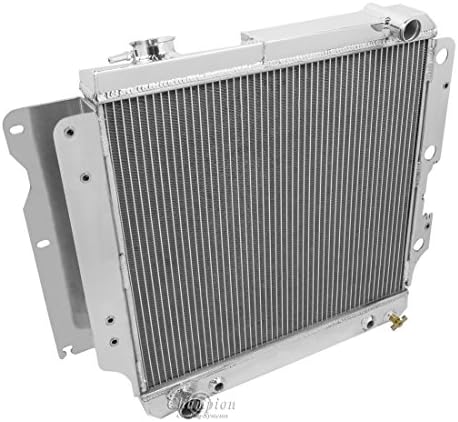
Champion Cooling CC2101 3 Row Aluminum Radiator
$284.99 price checked August 2026
Read our full Champion CC2101 Radiator review
If you are looking for a heavy-duty setup, see the top-rated options for Chevy and GMC trucks.

What Happens if You Under-Buy or Over-Buy Core Row Count?
Under-buying core row count means selecting a radiator with insufficient surface area to dissipate the heat generated by the engine. If the heat produced exceeds the radiator’s capacity, the coolant temperature will rise rapidly, leading to reduced engine efficiency and potential overheating. In severe cases, an under-provisioned radiator will fail to maintain safe operating temperatures during sustained high-load periods, which can cause permanent engine damage or the triggering of safety shut-offs.
Risks of Under-Provisioning
A 2-Row radiator on a high-output engine will reach its thermal limit quickly. This results in a “heat soak” effect where the coolant cannot shed heat as fast as the engine generates it. You may notice the cooling fans running at maximum duty cycle constantly, or the temperature gauge climbing steadily even when the vehicle is moving at highway speeds.
The Real Cost of Over-Buying
Over-buying core row count introduces physical and aerodynamic trade-offs that can negatively impact the vehicle’s performance. A 4-Row radiator has significantly more mass than a 2-Row unit, which can affect the weight distribution and handling characteristics of the front end. Furthermore, a thicker core creates a higher pressure drop for the coolant and requires more aggressive fan speeds to pull sufficient air through the extra layers of material.
Owners of older trucks can find a comparison of Dodge Dakota and Ram radiator units.
Aerodynamic Drag and Airflow
Larger core counts increase the frontal surface area and the thickness of the unit. This creates more aerodynamic drag, which can decrease fuel efficiency and reduce top speed. In some cases, a radiator that is too thick may also restrict the amount of air reaching the air conditioning condenser, potentially causing the AC system to lose cooling efficiency in hot weather.
The Mistake Most Buyers Make with Core Row Count
The most common mistake is assuming that a higher core row count automatically results in better cooling regardless of other factors. Many buyers select a 4-Row radiator for a moderate engine, only to find that the radiator is too thick to allow sufficient airflow through the core. This creates a “choked” cooling system where the surface area is large, but the air cannot pass through it fast enough to be effective.
Optimising for Airflow over Surface Area
Instead of focusing solely on the number of rows, you should optimise for the balance between core thickness and airflow velocity. A 3-Row radiator with high-efficiency fins and a high-flow fan shroud often outperforms a 4-Row radiator that is too dense for the vehicle’s natural airflow. Ensure that the radiator’s core density allows for the specific CFM (Cubic Feet per Minute) required by your engine’s heat output.
How Core Row Count Interacts with Other Deciding Specs
Core row count does not operate in a vacuum; its effectiveness is limited by the material and the fan assembly. If you select a high core row count but use a material with poor thermal conductivity, the extra rows will provide diminishing returns. The physical properties of the core material determine how quickly heat moves from the internal tubes to the outer surfaces where the air can strip it away.
Core Material Constraints
The material used in the radiator—such as aluminum or copper—sets the baseline for heat transfer. Aluminum is the standard for modern high-performance applications due to its weight-to-conductivity ratio. If the material is not suited for the heat load, adding more rows will not compensate for the slow heat transfer at the molecular level.
The Fan Shroud and Airflow Limits
The fan shroud and the fans themselves are the primary drivers of air movement through the core. A high core row count requires a fan capable of pushing air through a thicker stack of material. If the fan’s static pressure is insufficient to move air through a 4-Row core, the radiator will underperform regardless of how many rows it has. You must ensure the fan’s CFM rating matches the requirements of the chosen core count.
Physical Fitment and Clearance
Core row count directly impacts the physical dimensions of the unit. A higher row count usually means a deeper radiator. Before ordering, you must confirm that there is enough clearance between the radiator and the engine block or AC compressor. If the radiator is too deep, it may interfere with other components, making it impossible to mount correctly or causing it to strike the engine during operation.
Hose Connection Diameters
A higher core row count often requires a higher volume of coolant flow to remain effective. You should verify that the radiator’s inlet and outlet diameters are compatible with your existing cooling system’s hose sizes. If the radiator requires larger hoses to move enough fluid for its core size, you may need to replace your existing hose connections to avoid flow restrictions.