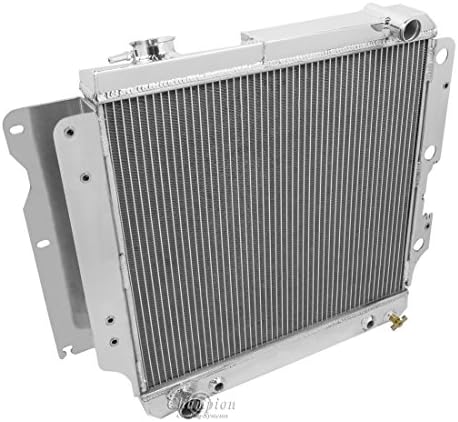
Core Height refers to the vertical measurement of the radiator’s cooling core, usually expressed in inches (in.). The specific height you require depends entirely on the physical clearance within your engine bay and the specific mounting points of your vehicle’s radiator support.
Which Core Height Suits Your Situation?
| If this is you | The Core Height that suits you | Why |
|---|---|---|
| You have a compact engine bay with a low hood line. | Lower Core Height (e.g., 12-14 in.) | This prevents the top of the radiator from striking the underside of the hood or interfering with hood hinges. |
| You own a truck or SUV with significant vertical space. | Standard Core Height (e.g., 16-18 in.) | These dimensions provide a balanced surface area for standard passenger vehicle heat dissipation without clearance issues. |
| You are installing a high-output racing engine. | High Core Height (e.g., 19+ in.) | Increased vertical surface area allows for more coolant volume and heat exchange, which is necessary for high-horsepower outputs. |
| You have a custom-built widebody or modified front end. | Specific Custom Height | Custom builds often require non-standard heights to clear modified fenders or aftermarket components like large intercoolers. |
Products in this category with a full review here
From $149 to $284.99: the 3 in this category we have reviewed in full.


How Do I Measure My Required Core Height?
To establish your required Core Height, you must measure the vertical distance between the top and bottom mounting points of your current radiator support frame.
Identifying the Measurement Points
Locate the upper and lower radiator brackets where the unit bolts to the vehicle. Measure the straight-line vertical distance between the center of the top mounting hole and the center of the bottom mounting hole.
Checking Overhead Clearance
Measure the distance from the top of your existing radiator to the nearest obstruction, such as the underside of the hood, the fan shroud, or the AC compressor. Your new Core Height must be at least 0.5 in. shorter than this clearance to allow for vibration and heat expansion.
Finding the Value in Documentation
If you prefer not to measure manually, look for the “Core Height” or “Radiator Height” specification in the manufacturer’s dimensions list. This value is usually listed in inches (in.) and refers specifically to the core, not the outer frame or the thickness of the end tanks.
What Happens if the Core Height is Wrong?
Choosing a Core Height that is incorrect leads to physical installation failures or significant cooling deficiencies.
Risks of a Core Height That is Too Tall
If the Core Height exceeds the available vertical space, the radiator will not seat correctly against the mounting brackets. This often results in the radiator being pushed forward or backward, which can cause the radiator hoses to pull out of their fittings or the unit to strike the cooling fan blades.
Risks of a Core Height That is Too Short
A Core Height that is too short for your engine’s output reduces the total surface area available for heat exchange. This can lead to rapid overheating, especially under heavy loads or in high-ambient-temperature environments, as the coolant cannot pass through enough surface area to shed heat effectively.
What Should I Do if I Fall Between Two Core Heights?
If your measurements place you between two standard Core Height offerings, you should prioritize the smaller height to ensure a safe fit.
Why the Smaller Height is Safer
A radiator that is slightly too short can be compensated for by the design of the end tanks, but a radiator that is even slightly too tall cannot be “shaved” down. If your measurement is 15.5 in. and the options are 15 in. and 16 in., the 15 in. unit is the only one that guarantees a fit without structural modification to the vehicle.
Confirming with a Qualified Installer
Before ordering, confirm your final measurement with a qualified technician who can verify the mounting point alignment. Because radiator mounting is a structural component of the cooling system, a professional can confirm if a specific Core Height will clear the radiator support and the fan shroud during full operation.