A Hub Bolt Pattern is the specific geometric arrangement of bolts that secures a wheel to a vehicle’s hub assembly. The correct pattern is determined entirely by your vehicle’s manufacturer and cannot be substituted with a different measurement.
Which Hub Bolt Pattern matches your vehicle?
| If this is you | The Hub Bolt Pattern that suits you | Why |
|---|---|---|
| You own a standard passenger car or SUV | Common 5-bolt patterns (e.g., 5×114.3 or 5×120) | These are standard for most modern consumer vehicles and ensure the wheel sits flush against the hub. |
| You drive a heavy-duty truck or large van | 8-bolt patterns (e.g., 8×165.1 or 8×170) | Larger vehicles require more bolts to distribute the higher weight and torque loads of the vehicle. |
| You are replacing a hub on a performance car | Specific high-load patterns (e.g., 5×112 or 5×139.7) | Performance requirements dictate specific spacings to maintain structural integrity under high-speed cornering. |
| You are working on a vintage or import vehicle | Non-standard or older metric/imperial patterns | Older vehicles often use unique spacings that require exact matching to the original factory specifications. |
Reviewed examples from this category
Prices across these 3 run from $180.29 to $292.55; each one has a full review here.
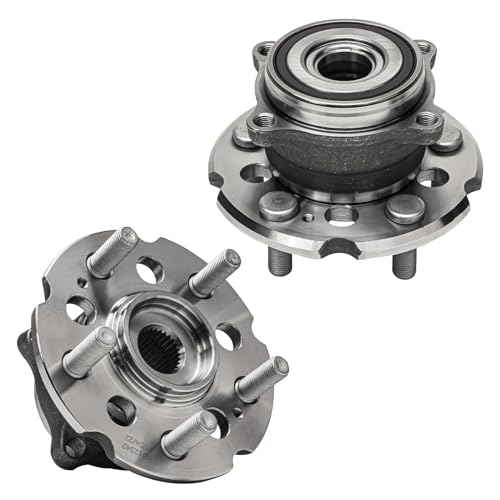
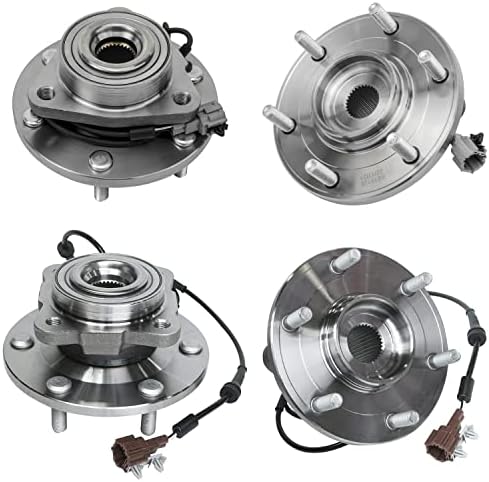
Detroit Axle Nissan Armada Infiniti QX56 Wheel Bearing
If you are upgrading a heavy-duty truck, see our comparison of Ford F-250 hub assemblies.
$292.55 price checked August 2026

Detroit Axle Wheel Bearing & Hubs Kit
$180.29 price checked August 2026
Read our full Wheel Bearing Hubs review
Truck owners can find our guide on selecting the best wheel bearing hub for Dodge Ram 2500.
How do I find my specific Hub Bolt Pattern?
To find your Hub Bolt Pattern, you must identify the distance between the centers of the bolt holes on your current hub or wheel. This measurement is typically expressed as two numbers, such as 5×114.3, where the first number is the count of bolts and the second is the diameter of the circle formed by those bolts in millimeters.
Using the Vehicle Identification Number (VIN)
The most accurate way to establish your value is to check the manufacturer’s specifications using your VIN. You can find this number on your dashboard or inside the driver’s side door jamb. Providing this number to a parts specialist ensures you receive the exact pattern required for your specific production year and trim level.
Taking a physical measurement of the hub
If you cannot access the VIN, you can measure the hub physically using a large caliper or a tape measure. Measure the diameter of the circle created by the bolt holes, not the distance between two individual holes. For example, if you measure a 114.3 mm diameter circle with 5 bolts, your Hub Bolt Pattern is 5×114.3.
Checking the wheel’s stampings
Most wheels have the Hub Bolt Pattern stamped directly onto the rear side of the wheel or on the center cap. Look for a sequence of numbers like 5×112 or 6×139.7. If the stamping is worn away, you must revert to the VIN or physical measurement methods to confirm the value.
What happens if the Hub Bolt Pattern is incorrect?
If the Hub Bolt Pattern is incorrect, the wheel will not physically bolt to the axle, preventing any installation. Because the bolt holes do not align with the studs, the hub assembly cannot be seated against the vehicle’s mounting surface.
Proper fitment also depends on the correct flange thickness for your wheel hubs.
The Hub Bolt Pattern Mismatch failure
A Hub Bolt Pattern Mismatch occurs when you attempt to mount a hub that does not match your vehicle’s bolt circle. The hub will not bolt to the vehicle’s axle because the holes are in the wrong locations. This is a hard physical failure that prevents the vehicle from being driven.
Safety risks of improper fitment
Attempting to force a hub that is close but not exact to the correct Hub Bolt Pattern can lead to severe structural failure. Even if the hub appears to sit, a mismatch in the bolt circle means the load is not distributed evenly across the studs. This can cause the hub to wobble, the studs to shear, or the wheel to detach entirely while the vehicle is in motion.
What if my measurement falls between two common patterns?
If your measurement falls between two common Hub Bolt Patterns, you must verify the exact decimal point of the diameter before ordering. In the wheel industry, a difference of even 1mm can be the difference between a safe fit and a total mismatch.
The importance of decimal accuracy
Hub Bolt Patterns often differ by very small increments, such as 5×114.3 versus 5×112. If your measurement is near a common standard, do not guess the decimal. A 2.3mm difference may seem small, but it prevents the wheel from sitting flush against the hub, leading to a dangerous gap between the wheel and the braking components.
Final verification before purchase
When in doubt, verify the value through the vehicle’s service manual or by contacting a certified dealer. Because a Hub Bolt Pattern is a fixed engineering standard, there is no “close enough” measurement. If your measurement does not perfectly match a known standard for your vehicle, re-measure the hub diameter to ensure the tape measure or caliper was used correctly.
Consulting a qualified installer
Because Hub Bolt Pattern selection involves critical safety components, it is advisable to have a qualified mechanic confirm the requirements for your specific vehicle. A professional can verify the Hub Bolt Pattern and ensure that the ABS sensor types and hub bore diameters also match your vehicle’s requirements before the part is ordered.