When evaluating a wheel hub, the most load-bearing terms relate to physical dimensions and electronic compatibility. These are the non-negotiable specifications that determine if a hub will physically bolt to your vehicle and allow the safety systems to function. Conversely, many listings use marketing vocabulary to describe “heavy-duty” construction or “high-performance” materials without providing specific engineering standards. To make an informed choice, ignore subjective descriptors and focus on the specific bolt patterns, bore diameters, and sensor types provided in the technical data.
Physical Dimensions and Mounting Specs for Wheel Hubs
Physical dimensions and mounting specs for wheel hubs dictate the mechanical interface between the vehicle’s axle and the wheel assembly.
- Hub Bolt Pattern – This is the number of studs and the diameter of the circle they form, such as 5×114.3 or 6×139.7. You must match your vehicle’s existing bolt pattern exactly, as a mismatch means the hub will not physically bolt to the axle.
- Hub Bore Diameter – This is the diameter of the center hole where the wheel sits. You need to ensure the hub bore is large enough to accommodate your wheels, but not so large that the wheel wobbles; matching the OEM (Original Equipment Manufacturer) diameter is the standard for a secure fit.
- Flange Thickness – This measures the thickness of the mounting surface. You must match the flange thickness of the original hub to ensure the wheel sits at the correct distance from the vehicle’s frame and maintains proper clearance.
- Spline Count – This refers to the number of teeth on the hub’s inner diameter where it slides onto the axle. If the spline count does not match your vehicle’s axle, the hub will not slide into place.
- Hub Offset – This is the distance from the mounting surface to the center of the hub. You need to verify that the offset matches your vehicle’s requirements to ensure the wheels are centered correctly on the axle.
Where these choices show up in our reviews
These 3 have their own full review on this site, and run from $139.72 to $169.95.
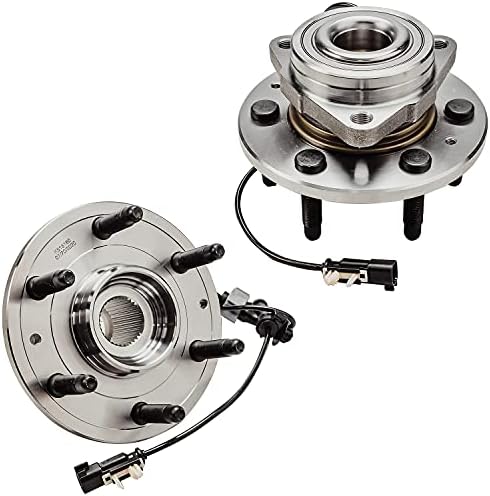
Detroit Axle Front Wheel Bearing Hub Assembly
$145.78 price checked August 2026
If you are just starting out, find affordable hub options for beginners to see which models fit a tighter budget.
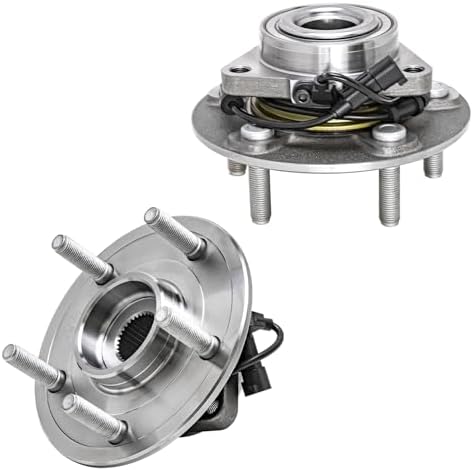
Detroit Axle Front Wheel Bearing Hubs Ram 1500
$169.95 price checked August 2026
Heavy-duty owners can view our comparison of Ford F-250 hubs to find a durable mounting solution.
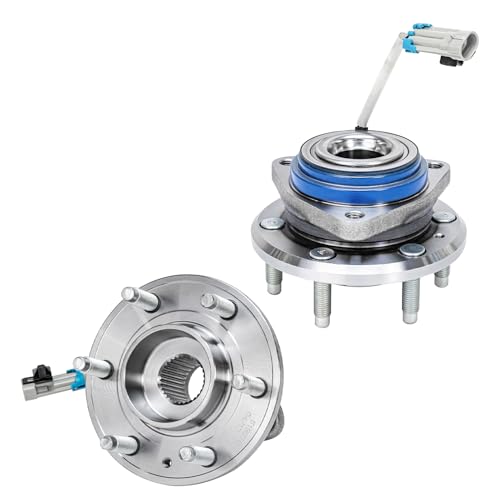
Detroit Axle Cadillac STS V Front Wheel Hub
$139.72 price checked August 2026
To understand the different designs available, learn about various wheel hub types and their specific applications.
Electronic and Sensor Compatibility for Wheel Hubs
Electronic and sensor compatibility for wheel hubs ensures that the vehicle’s computer can communicate with the wheels for safety and stability.
- ABS Sensor Type – This defines whether the hub uses an Active or Passive sensor. You must match the sensor type provided by your vehicle’s manufacturer, as an incorrect type will prevent the Anti-lock Braking System from functioning.
- Tone Ring Diameter – This is the diameter of the notched ring that the ABS sensor reads. You need to match the diameter specified by your vehicle to ensure the sensor accurately tracks wheel speed.
- Sensor Position – This describes the physical location of the sensor (e.g., “top,” “bottom,” or “side”). You must ensure the sensor is positioned in the same location as the original to prevent signal interference.
- Encoder Count – This refers to the number of teeth on the tone ring. A higher number provides more data points to the computer, but you must match the specific count required by your vehicle’s electronic control unit.
- IP Rating – This measures the hub’s resistance to dust and water ingress, such as IP67 or IP68. A higher IP rating is better for longevity in harsh environments or for vehicles frequently exposed to deep water.
Bearing and Material Standards for Wheel Hubs
Bearing and material standards for wheel hubs determine the internal durability and heat dissipation of the assembly.
For a basic overview of the mechanics, see how a wheel hub operates to understand its core function.
- Bearing Type – This refers to the internal design of the hub’s bearings, such as tapered roller bearings or ball bearings. Tapered bearings are generally preferred for heavy loads as they handle both radial and axial forces.
- Bearing Grade – This is a manufacturing standard (such as ABEC ratings) that defines the precision of the bearings. A higher grade indicates tighter tolerances and smoother operation.
- Seal Material – This describes the material used to keep grease in and contaminants out, such as rubber or metal-shielded seals. High-quality seals are essential to prevent premature bearing failure.
- Material Grade – This refers to the type of steel or alloy used to forge the hub body. Using a high-carbon steel or forged construction provides better durability under high-torque conditions.
- Grease Type – This is the lubricant used inside the hub, often specified by its operating temperature range. A grease rated for higher temperatures is better for heavy-duty use or high-speed driving.
Commonly Confused Wheel Hub Terms
Buyers often confuse several wheel hub terms that have distinct roles in the assembly’s fitment and function.
Hub Bolt Pattern vs. Hub Bore
Hub bolt pattern refers to the layout of the studs (the outer mounting), while hub bore refers to the diameter of the center hole (the inner mounting). You must verify both, as a hub can have the correct bolt pattern but a bore diameter that is too small for your wheels.
ABS Sensor vs. Tone Ring
The ABS sensor is the electronic component that reads data, while the tone ring is the physical notched circle it reads from. While they work together, the tone ring is a physical part of the hub’s geometry that must match the vehicle’s specific diameter.
Bearing Type vs. Bearing Grade
Bearing type describes the physical shape and function of the internal rolling elements (like tapered rollers), whereas bearing grade refers to the precision and manufacturing quality of those parts. You need the correct type for your vehicle’s load requirements and a high grade for longevity.