Weight in a dual mass flywheel (DMF) refers to the specific mass of the rotating components measured in kg. The correct weight depends entirely on your vehicle’s engine displacement and the specific torque requirements of the original equipment manufacturer (OEM).
Which Weight Suits Your Situation?
| If this is you | The Weight that suits you | Why |
|---|---|---|
| You own a small-displacement passenger car (e.g., 1.0L to 1.6L) | Lower weight range (typically 6kg to 10kg) | Smaller engines require less rotational inertia to maintain smooth operation and efficient fuel economy. |
| You own a mid-sized SUV or a larger sedan (e.g., 2.0L to 3.0L) | Mid-range weight (typically 10kg to 15kg) | These engines require a balance between vibration damping and the ability to rotate the mass quickly. |
| You own a heavy-duty truck or a high-torque diesel vehicle | Higher weight range (typically 15kg to 25kg+) | High torque outputs necessitate a heavier flywheel to provide sufficient inertia and prevent harmonic resonance. |
| You are replacing a failed unit on a performance-tuned vehicle | OEM-specific weight (exact match) | Modifications to torque output can change requirements, but the base weight must align with the crankshaft’s physical limits. |
Dual Mass Flywheels covered by our own reviews
3 reviewed options, $101.13 to $479, with the full write-up behind each name.


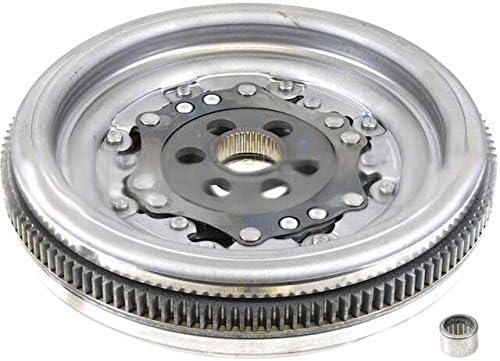
Dual Mass Flywheel for Volkswagen Jetta 2.0L Diesel
If you are shopping on a budget, explore affordable automatic transmission flywheels under $250.
$440.95 price checked August 2026
How Do I Find My Correct Flywheel Weight?
To find the correct weight for your dual mass flywheel, you must identify the exact weight required by your vehicle’s specific engine configuration. This is not a value you can estimate by comparing similar vehicles, as even small changes in engine displacement can shift the required mass.
Locating the OEM Part Number
The most reliable way to determine the correct weight is to locate the Original Equipment Manufacturer (OEM) part number for your vehicle. This number is often found on a sticker or stamped metal plate located on the transmission housing or the flywheel itself.
The OEM part number ensures that the specific casting and tooth count match your vehicle’s production run. You should provide this number to a specialist to confirm the exact weight in kg required for your specific manufacturing year and region.
Consulting Technical Data Sheets
If the physical part is no longer on the vehicle, you can establish the weight by referencing the technical data sheets provided by the vehicle manufacturer. These documents list the engineering specifications for every component, including the mass of the dual mass flywheel.
When searching these records, look for the “Mass” or “Weight” specification listed in kg. Ensure you are looking at the correct engine code, as a 2.0L petrol engine and a 2.0L diesel engine will almost always require different flywheel weights.
Verification by a Qualified Installer
Because the fitting of a dual mass flywheel is a job for a qualified installer wherever local rules require one, professional verification is a standard step. A qualified mechanic can confirm the weight requirements by cross-referencing your vehicle’s VIN (Vehicle Identification Number) with the manufacturer’s parts catalog.
This verification ensures the flywheel aligns with the pilot journal diameter and bolt pattern of your specific crankshaft. It is the most reliable method to avoid ordering a component that is physically incompatible with your vehicle’s internal architecture.
Understanding the technology is easier when you examine different types of dual mass flywheels.
What Happens if the Weight is Wrong?
Selecting a weight that is either too low or too high for your specific engine will result in measurable performance issues and potential mechanical failure. Because the dual mass flywheel is designed to manage the transition of power from the engine to the gearbox, the weight must be precise.
Risks of a Weight That is Too Low
If the flywheel weight is too low for the engine’s torque output, the vehicle may experience “hunting” or erratic RPM fluctuations during acceleration. A lighter mass lacks the inertia required to smooth out the combustion pulses of a larger engine.
In severe cases, an under-weighted flywheel can lead to harmonic resonance. This occurs when the mass distribution is insufficient to damp vibrations, causing premature bearing wear and potential damage to the input shaft of the gearbox.
Risks of a Weight That is Too High
A flywheel weight that is too high for a small engine will result in sluggish throttle response and increased rotational inertia. The engine must work harder to spin the heavier mass, which can lead to increased wear on the clutch disc and reduced fuel efficiency.
Furthermore, an excessively heavy flywheel can cause a “lazy” feeling in the gear changes. Because the mass takes longer to accelerate, the engagement of the gears may feel delayed or heavy, making the vehicle feel less responsive in city driving.
What if My Vehicle Falls Between Two Weight Values?
If your vehicle’s specifications fall between two common weight values, you must prioritize the weight that matches the OEM engineering standard for your specific engine displacement. There is no “middle ground” calculation; the flywheel must match the design intended by the manufacturer.
The Engine Displacement Rule
When caught between two values, the rule of thumb is to select the weight associated with the closest engine displacement. If your engine is 1.9L and the options are for 1.8L and 2.0L, the 2.0L weight is often the closer engineering match for the torque curve.
However, because dual mass flywheels are highly engineered components, you should always confirm the specific casting requirements. If the weight difference is marginal, the manufacturing standard for your specific vehicle’s production year will dictate the correct choice.
Consulting the Manufacturer
In borderline cases, the safest course of action is to contact the manufacturer of the replacement component with your full VIN. They can identify the exact engineering architecture required for your vehicle’s production run.
This ensures that the flywheel’s mass distribution is correct for your vehicle’s specific torque profile. Selecting the wrong weight in a borderline scenario can lead to a bolt pattern mismatch or a pilot journal diameter issue, where the flywheel physically will not seat against the crankshaft flange.