There are three primary types of dual mass flywheels (DMF) distinguished by their engineering architecture and intended application. These types are separated by how they manage torsional vibration and heat dissipation, which dictates whether the unit is suitable for a high-torque diesel engine, a smooth-running passenger car, or a high-performance application. Choosing the correct type depends on matching the flywheel’s internal damping characteristics to your vehicle’s specific engine displacement and torque curve.
What is a standard dual mass flywheel?
A standard dual mass flywheel is defined by two separate friction surfaces connected by internal springs that allow the two halves of the flywheel to move independently. This design is the most common type of DMF used in modern passenger vehicles to dampen the vibrations produced by the crankshaft. If you drive a standard gasoline or diesel passenger car, this is likely the type required to ensure smooth gear changes and reduced cabin noise.
Benefits of standard DMF designs
The primary advantage of a standard DMF is its ability to isolate the transmission from engine vibrations, which extends the life of the clutch and gearbox components. By allowing the two masses to oscillate at different frequencies, the unit absorbs the harmonic resonance that would otherwise cause premature bearing wear. It provides a balance of durability and comfort, making it the baseline for most consumer vehicles.
Cost positioning of standard DMFs
Standard dual mass flywheels sit in the middle of the price spectrum. They are more expensive than single-mass flywheels due to the complex internal spring assembly but are significantly less expensive than specialized high-performance variants. They represent the standard replacement cost for most general maintenance.
Where these choices show up in our reviews
Prices across these 3 run from $219 to $319.30; each one has a full review here.

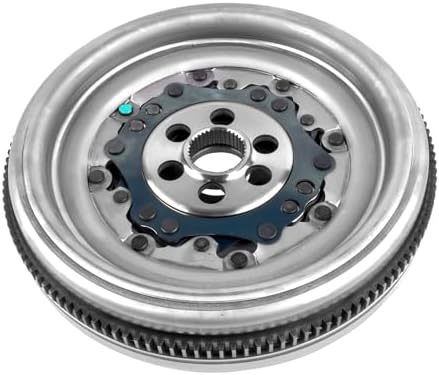

Schaeffler LuK DMF063 Dual Mass Flywheel
For a deeper dive into the basics, see how a dual mass flywheel works.
$319.30 price checked August 2026
What is a high-torque dual mass flywheel?
A high-torque dual mass flywheel is engineered with heavier internal damping components and reinforced spring rates to handle the extreme twisting forces of large-displacement diesel engines. This type is for users who need to manage high-torque output without the risk of internal spring failure or “clunking” during engagement. It provides superior stability under heavy loads but adds significant weight to the drivetrain.
Torque handling and weight
Because these units must withstand higher Newton-meters of force, the internal components are beefier than standard units. While this makes the flywheel more durable under load, the increased mass can slightly increase the rotational inertia of the engine. If you are operating a heavy-duty commercial vehicle or a large truck, this type is necessary to prevent the flywheel from reaching its mechanical stress limits.
Cost positioning of high-torque DMFs
High-torque dual mass flywheels sit at the higher end of the price band. The manufacturing complexity required to ensure the internal springs can withstand high-pressure cycles increases the cost relative to standard passenger car units.
What is a performance dual mass flywheel?
A performance dual mass flywheel is characterized by specialized materials and a focus on rapid heat dissipation to handle aggressive driving cycles. This type is for enthusiasts who require the vibration damping of a DMF but need the thermal capacity to withstand repeated high-load shifts. It gives up some of the longevity of a standard unit in exchange for better thermal management and a more immediate engagement feel.
Thermal management and materials
Performance units often use specific alloys or surface treatments to shed heat faster than standard designs. This prevents the “spongy” feeling that can occur when a standard DMF becomes too hot during rapid shifting. If you frequently drive in a high-stress environment where the clutch is frequently engaged and disengaged, this type provides the necessary thermal headroom.
Cost positioning of performance DMFs
Performance dual mass flywheels represent the highest price tier in this category. The use of specialized materials and precision engineering for high-heat environments makes them the most expensive option for the buyer.
Comparison of dual mass flywheel types
| Flywheel Type | Best-fit Buyer | Main Advantage | Main Compromise |
|---|---|---|---|
| Standard DMF | Passenger car owners | Smooth vibration damping | Limited torque capacity |
| High-Torque DMF | Diesel and truck owners | High load durability | Increased rotational mass |
| Performance DMF | Enthusiast drivers | Rapid heat dissipation | Higher price point |
How do you choose the right dual mass flywheel?
To determine which dual mass flywheel type fits your situation, you must check your vehicle’s engine displacement and the intended use of the vehicle. If you are replacing a unit in a standard commuter car, the standard DMF is the correct choice for maintaining factory-spec smoothness.
Checking for high-torque requirements
You should select a high-torque dual mass flywheel if your vehicle has a diesel engine with a displacement exceeding 2.5 litres or if the vehicle is used for towing and heavy hauling. These conditions indicate that the crankshaft produces enough torque to exceed the damping limits of a standard unit, which could lead to harmonic resonance issues or premature failure.
Checking for performance requirements
You should consider a performance dual mass flywheel if the vehicle is used for track days or high-performance driving where the clutch is engaged frequently under heavy load. If your primary concern is the “feel” of the engagement and the ability of the unit to shed heat quickly, this type is the appropriate choice over the standard or high-torque options.
Technical requirements for installation
Before ordering any dual mass flywheel, you must confirm the specific OEM part number and pilot journal diameter for your vehicle. A mismatch in the pilot journal diameter or the bolt pattern will prevent the flywheel from seating against the crankshaft flange. Because these components are precision-engineered, the installation must be performed by a qualified mechanic to ensure proper alignment and torque specifications are met according to local regulations.