When researching dual mass flywheels (DMF), most of the technical data points relate to mechanical compatibility and material durability. Terms like “harmonic damping” and “mass distribution” are load-bearing specifications that dictate how the part handles engine vibration. Conversely, many listings use marketing descriptors like “high-performance” or “smooth-shift” which are subjective. You should prioritize measurable specs—such as the pilot journal diameter, bolt patterns, and specific OEM reference numbers—over descriptive adjectives to ensure the part actually fits your vehicle.
Dual Mass Flywheel Capability and Performance Terms
- Harmonic Damping – This refers to the ability of the dual-mass design to absorb engine vibrations before they reach the transmission. A higher damping capacity generally indicates a more robust design capable of handling higher-torque engines.
- Mass Distribution – This describes how the weight of the flywheel is balanced around the center axis. Precise mass distribution is critical to prevent harmonic resonance, which causes premature bearing wear.
- Torsional Vibration – This is the twisting motion of the crankshaft during combustion cycles. A dual mass flywheel is designed to counteract this specific movement; the more effective the damping, the smoother the power delivery.
- Damping Spring Rate – This is the specific resistance of the internal springs between the two flywheel masses. A higher spring rate may be necessary for heavy-duty applications, while a lower rate is often found in passenger vehicles for smoother engagement.
- Moment of Inertia – This measures the flywheel’s resistance to changes in rotational speed. A higher moment of inertia helps with smooth acceleration but can slightly increase the time it takes to reach cruising speeds.
Where these choices show up in our reviews
These 3 have their own full review on this site, and run from $159.13 to $319.30.
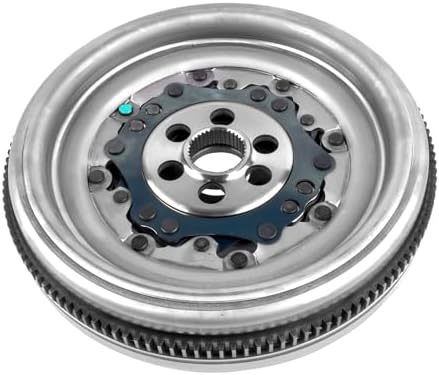
VW Jetta Golf Beetle 2.0L Dual Mass Flywheel
$219 price checked August 2026
Read our full Dual Mass Flywheel review
Owners of vintage models can find the best dual mass flywheel for Beetle owners to consider.

Schaeffler LuK DMF063 Dual Mass Flywheel
$319.30 price checked August 2026
Read our full LuK DMF063 review
If you are performing repairs, see the best dual mass flywheel for replacement options.
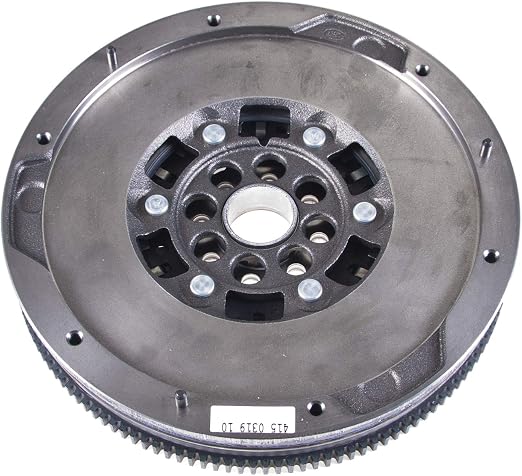
LuK DMF117 Dual Mass Flywheel
$159.13 price checked August 2026
Read our full LuK DMF117 review
You can learn more about different designs by viewing the different types of dual mass flywheels available.
Dual Mass Flywheel Physical and Material Specifications
- Pilot Journal Diameter – This is the diameter of the hole in the center of the flywheel where the input shaft sits. You must match this dimension exactly to your vehicle; a mismatch means the flywheel will not seat against the crankshaft flange.
- Bolt Pattern – This refers to the specific arrangement and number of holes used to mount the flywheel. Even a slight variation in spacing prevents installation, so you must verify this against your existing component.
- Material Grade (e.g., 18/10 Stainless Steel) – This indicates the chemical composition and durability of the metal. Higher-grade materials, like 18/10 stainless steel, offer better resistance to heat and fatigue than lower-grade alloys.
- Weight (kg/lbs) – This is the total mass of the unit. While weight varies by engine size, the goal is to match the OEM weight closely to maintain the vehicle’s balanced dynamics.
- Thickness – This is the physical depth of the flywheel. Correct thickness is required to ensure the clutch disc has the proper surface area for engagement.
Dual Mass Flywheel Compatibility and Standards
- OEM Part Number (e.g., 03G105266BD) – This is the manufacturer’s specific identifier for the original part. Matching the OEM number is the most reliable way to ensure the casting and tooth count match your specific production run.
- LuK DMF Series (e.g., DMF092) – This identifies a specific engineering architecture used by manufacturers to define the design for different engine displacements. Knowing the series helps identify the correct architecture for your engine type.
- Reference Tier (OEM vs. Aftermarket) – This distinguishes between the original equipment and third-party replacements. OEM-tier parts serve as the baseline for vibration damping and material fatigue life.
- Reference Tier (Sachs / Exedy) – These are the primary high-performance competitors used to benchmark aftermarket durability. Comparing a part against these standards helps determine its expected service life.
- Tooth Count – This is the number of teeth on the flywheel’s friction surface. The count must be identical to the original part to ensure the clutch disc meshes correctly.
Commonly Confused Dual Mass Flywheel Terms
Dual Mass Flywheel vs. Single Mass Flywheel
A dual mass flywheel (DMF) consists of two plates connected by internal springs to dampen vibration, whereas a single mass flywheel is a solid piece of metal. You should choose a DMF if your vehicle was designed for it, as a single mass flywheel may not handle the vibration levels of certain engines.
Pilot Journal vs. Crankshaft Flange
The pilot journal is the center hole that aligns the input shaft, while the crankshaft flange is the outer mounting surface. You must verify both: the journal must be the correct diameter, and the bolt pattern on the flange must match your engine’s mounting points.
Harmonic Resonance vs. Torsional Vibration
Torsional vibration is the physical twisting of the shaft during operation, while harmonic resonance is the resulting vibration frequency that can damage components. A dual mass flywheel is designed to prevent torsional vibration from becoming harmonic resonance.
DMF Series vs. OEM Number
A LuK DMF series is a general engineering architecture (like a blueprint), while an OEM part number is the specific identifier for your vehicle’s exact production year and configuration. You should prioritize the OEM number for compatibility, but the series can help confirm the engineering style.